Short answer — for Google, for AI, and for you
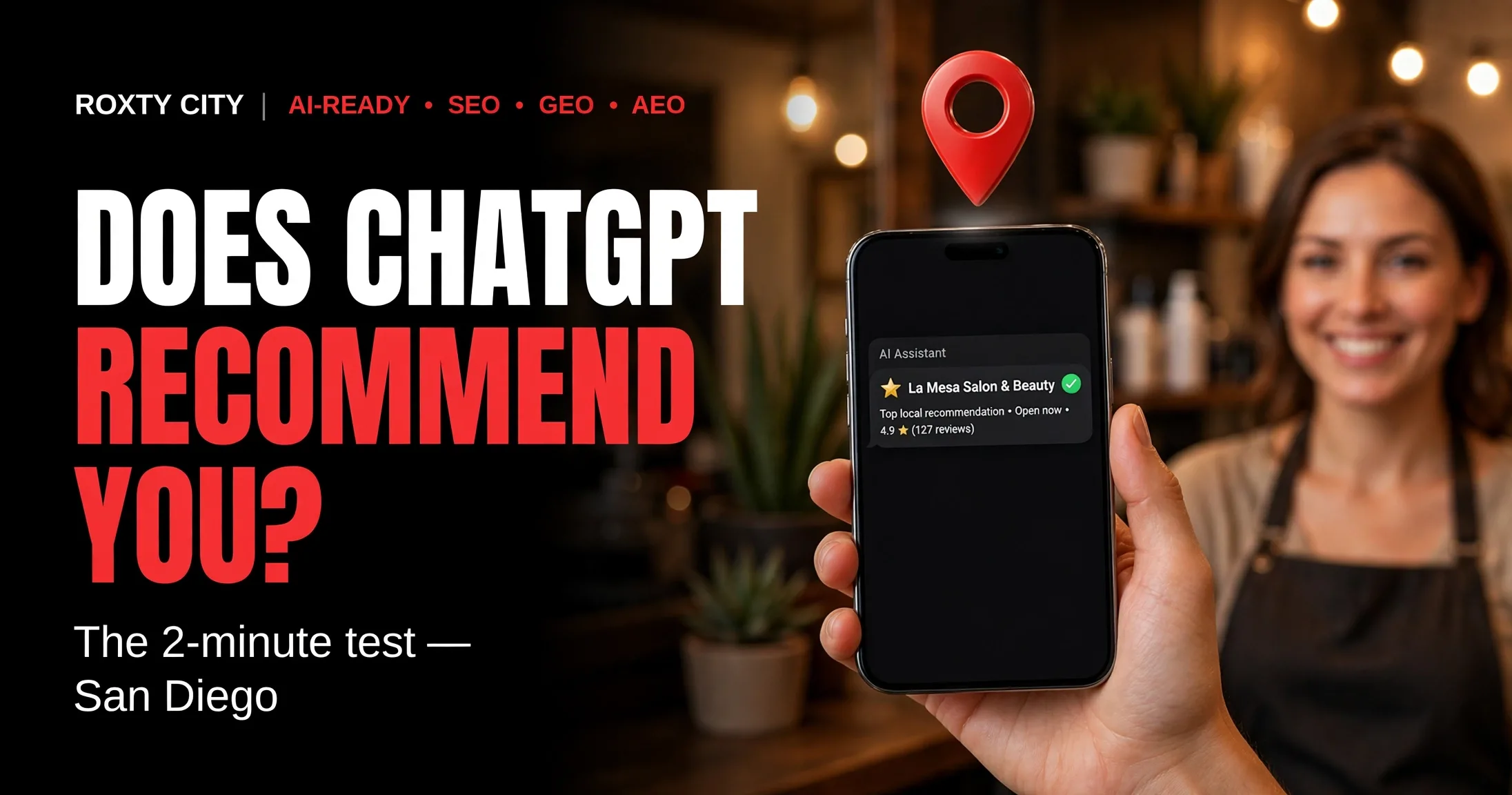
If a customer asks ChatGPT, Perplexity, or Google today: "best salon near me in San Diego," does it name you — or does it name your competitor?
That is the new question. It used to be enough to show up on Google. Today AI answers directly, with one or two options, often without the customer clicking anywhere.
In 2026, 45% of consumers in the United States already used AI for local business recommendations, up from just 6% in 2025, according to BrightLocal. And 97% read reviews before choosing. This is not the future. It is the customer searching right now.
This is not theory. It is a test you can do in 2 minutes, from your phone. At the end I will tell you what to fix first if you do not show up.
The 2-minute test — do it now
You do not need a paid tool. Do it the way a real customer would.
Step 1 — Ask like a customer, not like an owner.
Open ChatGPT, Perplexity, or Google AI Mode and type, in your own words:
- "best [your service] near me in San Diego"
- "best [your service] in [your neighborhood: Mission Valley, Chula Vista, La Jolla, North Park] with good reviews"
- "[your service] open now near me"
Real example: "best salon for keratin in Mission Valley San Diego" or "best Mexican restaurant near me in San Diego."
Step 2 — Write down 4 things.
- Does it name you? Yes / No.
- Who does it name instead? Those are your direct competitors in AI.
- Does the link go to your website, your Google listing, or a directory?
- Is the information right or outdated? Hours, services, phone, address.
Step 3 — Repeat it in English and in Spanish.
If you serve customers in both languages, test in both. Many San Diego businesses lose in Spanish because their site is only done well in English, or the other way around.
Step 4 — Do the same in Google Maps.
Search the same thing in Maps. Ask Maps, Google's conversational search in Maps with Gemini, arrived in the U.S. in March 2026. If you are not in the top 3 in Maps, you will not be first in AI either.
If you were named, with correct information and a link to your site, great. Save that screenshot. If you were not named, or you were named with old data, keep reading. That is the work.
Why AI names you — or does not name you
Google said it clearly in its official guide in May 2026: optimizing for AI is still SEO. There is no secret trick, no magic file, no special schema that forces your way in.
AI recommends you when it can trust what it says about you. And it trusts 3 things, the same ones as always in local Google: relevance, distance, and prominence.
In plain owner language:
1. Relevance: is it clear what you do, for whom, and where?
Your website has to say it in simple language, on the first screen, not hidden in a PDF or a photo. "Hair studio in Mission Valley specializing in keratin, hair botox and nanoplasty. Booking is one tap away." A customer understands that. AI understands that too.
If your site says "welcome to our space where beauty blooms," AI does not know if you do keratin, nails, or massages. And it will not recommend you.
2. Consistency: do your Google listing, your website, and your socials say the same thing?
Name, address, phone, hours, services, and prices. If Google says one thing and your website says another, AI does not know which one to believe. In September 2026 Google tested a panel that describes your business with AI, based on your listing and your website. If your information is old, AI repeats the old information.
Do the year-end audit: holiday hours, services you no longer offer, old menu or prices, photos from 3 years ago. That is the first thing to fix.
3. Prominence: do people talk well about you, recently?
Recent reviews, real photos, mentions on other sites, a fast mobile site. 97% read reviews, and AI reads them too. It is not the total number that matters most, it is that they are recent and steady.
That is why the Queens Hair Studio case matters. Martha Calvillo, owner of Queens Hair Studio by Lorena in Mission Valley, said in her Google review in October 2026: "I now receive 3 to 5 new clients every week who tell me they found my salon while searching for services on Google." That is not an ad. That is a new client every week who arrived by searching on Google. That is real prominence.
5 fixes that actually move the needle — in this order
Do not start with the expensive thing. Start with what AI reads first.
1. Your Google listing, complete and up to date.
Correct category, complete services, hours, recent photos, clear description. It is free and it is the number 1 source for local AI. If you only do one thing this week, do this.
2. One clear page per service.
Not one page that says "services." One page for keratin, one for cut, one for color. Or one for tacos, one for catering. With price or range, duration, what is included, and a booking button. That is AEO: being the answer when someone asks "how much?" or "what is included?"
3. New reviews, asked for the right way.
Asking for reviews is allowed. What Google banned in 2026 is paying for them, filtering only happy customers, putting quotas on your team, or telling them what to say. Ask for an honest review after a good service, with a direct link. 5 to 10 a month, steady, is worth more than 100 from 2 years ago.
4. Your site, fast on a phone.
If it takes more than 3 seconds, 53% leave. And only 48% of mobile pages pass all three Core Web Vitals. This is not a technical detail. It is a customer leaving for your competitor because your site did not load on their phone.
5. Booking in one tap.
69% stopped going to a salon or spa appointment because booking was too hard. In restaurants, 76.9% prefer to book online. If your customer has to call you during office hours to book, you are losing the 9 p.m. customer. WhatsApp, online booking, and phone — all three, not one or the other.
What will NOT save you — even if someone tries to sell it to you
- An llms.txt file. Google said in June 2026 that it ignores them. 97% of those files never received a single request in May 2026. Do not spend money on that.
- A magic schema for AI. Google said it too: there is no special schema needed to appear in AI. LocalBusiness schema does help make your information clear, but it is not a key.
- Blocking AI bots out of fear. Each AI has different bots for search and for training. Blocking the training bot does not remove you from search. Blocking the search bot does. Do not block without knowing which is which.
- Buying reviews or asking for reviews with a script. In April 2026 Google started pausing reviews and showing a notice when it detects a spike in fake reviews. In 2025 it removed more than 292 million reviews that violated its policies. It is not worth the risk.
If an agency sells you one of these as "the AI solution," ask for the Google source. I just gave you the sources. That is the difference between strategy and hype.
What if you do not appear in AI? It is not the end, it is a signal
You do not disappear overnight. Google is still the main door and the local map pack is still alive. Only 7.9% of local searches trigger an AI Overview, compared to more than 70% in general searches.
But the risk is silent: you do not see that you are being left out, because there is no click to measure. You do not get a notice that says "ChatGPT recommended your competitor 20 times this week." You notice it when calls go down and you do not know why.
That is why the 2-minute test matters. Do it today, save it, and repeat it in January. If in January you still do not appear, it is not bad luck. It is outdated information, a site that does not clearly explain what you do, or an incomplete Google listing.
My work: getting you found on Google, Maps, and AI
I am José Luis Blancas, from Roxty City. I have spent 25 years making sure you get found. I am not a big agency with 20 people and a $5,000-a-month contract. I am one real person, who answers you, who visits your business, and who builds your site so you get found on Google, on Maps, and now in AI, in English and in Spanish.
What I do is simple to explain: SEO so Google finds you, AEO so you become the answer, GEO so AI recommends you, and MAP so your neighbors choose you. All with your brand, your photos, your real customers, and booking in one tap.
If you did the test and you did not show up, or you showed up with old data, start with the free check-up. It takes one minute, no account, no pressure. I will tell you in plain English what is working and what is holding you back.
Get the free check-up at roxtycity.com — or WhatsApp me at (619) 653-8688.
Your business is great. Make sure AI knows it too.