Lately I keep hearing the same thing: "Luis, they told me I need an llms.txt file so AI will recommend me. Can you add it?"
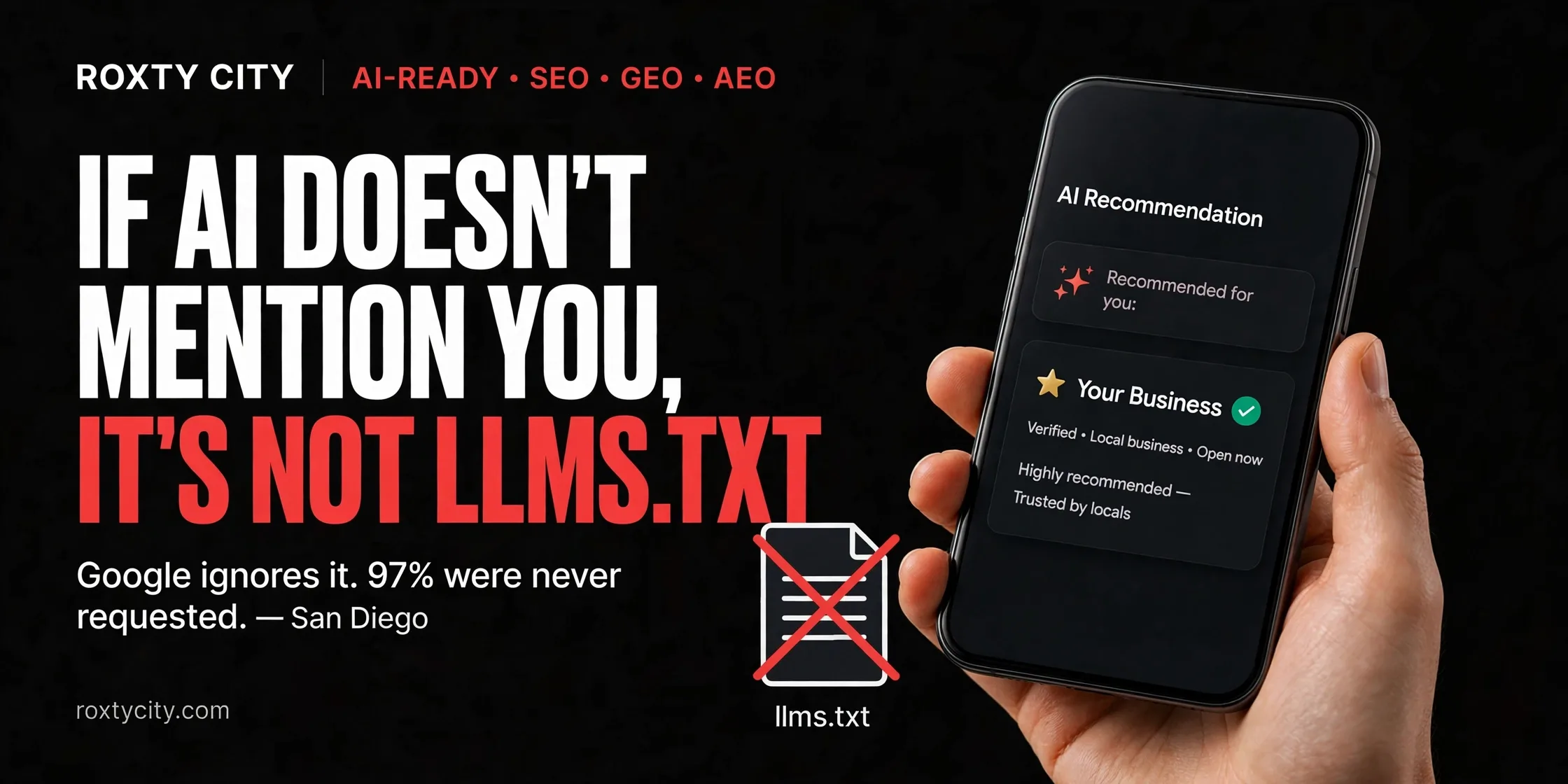
Let me say it clearly from the start: if AI does not mention you, it is not because you lack llms.txt.
It is not that the file is bad. It is that it is not what decides whether they recommend you or not. And paying for that alone is paying for the part that matters least.
What is llms.txt?
It is a text file you put on your site, at the root, to tell AI models which pages you have and what each one says, in a simple format for them.
The idea sounds good: if AI can read your site more easily, it will recommend you more.
The problem is that the idea did not work out the way it was sold.
What Google said
On June 15, 2026, Google said its search ignores llms.txt. It does not use it.
And in June 2026, Ahrefs checked thousands of sites and found that 97% of llms.txt files never received a single request in May 2026. 97%. Nobody asked for them. Not Google, not AI bots, almost nobody.
That does not mean the file hurts you. It means adding it will not make you show up. It is like putting a new sign on a closed store: the sign does not open the store.
Google said it clearly in May 2026: optimizing for AI "is still SEO". There is no separate trick, no magic file. It is the same work, done well.
So why don't you show up?
Because AI does not recommend you for a file. It recommends you for what it can verify about you.
When someone asks "best salon near me in San Diego", AI looks for the same thing a customer would look for, only faster: do you really exist? Where are you? What do you do? What do people say about you? Can they book with you?
If that is not clear, it will not recommend you. Not because of llms.txt. Because of everything else.
What actually decides if they recommend you
1. Your Google listing is complete and up to date
It is the first thing AI reads. Verification, name, phone, address, category, services, hours, and reviews. If your listing is incomplete, AI has nothing to hold on to.
Do the 10-point audit from my last blog. If you score under 7, start there, not with llms.txt.
2. Your website clearly says what you do, one page per service
AI does not recommend a confusing website. It recommends a website it understands in seconds.
One clear page per service, with its name, what it includes, who it is for, and how to book. No jargon. In English and in Spanish, if you serve both sides.
If your whole business is on one page, all mixed up, AI does not know which part to cite.
3. You have new reviews, and you answer them
97% read reviews before choosing, according to BrightLocal 2026. AI reads them too.
New reviews every month, answered by you, with your name. That tells AI you are active, you respond, you are real.
A listing with no new reviews looks abandoned, even when your business is not.
4. Your data is structured, not just pretty
This part is technical, but simple: your website needs structured data, schema, so Google and AI understand what you are: a restaurant, a salon, a clinic, your hours, your phone, your address, your services.
That is not an llms.txt file. It is your website's code, done well. It is part of the same SEO as always.
If your website has no schema, or it is wrong, AI has to guess. And when it guesses, it prefers the one that has it clear.
5. Your website is fast on a phone
Most people search on a phone. If your website is slow, the customer leaves, and AI notices.
You do not need a perfect score. You need it to load fast, read well on a phone, and let people book in one tap.
6. Others talk about you, not just you
AI trusts you more when others mention you: reviews on Google, your listing, local directories, your Instagram, a blog that cites you.
It is not buying links. It is being a real business, with a real presence, that people mention.
The 2-minute test
Do it like in the ChatGPT blog:
- Ask ChatGPT like a customer: "best [your service] near me in San Diego".
- Note: does it name you? Who does it name instead of you? Is the link to your website or to Google? Is the information up to date?
- Repeat it in English and in Spanish.
- Do the same on Google Maps.
If you are not in the top 3 on Maps, you will not be first in AI either. And that is not fixed with an llms.txt file. It is fixed with your listing, your website, and your reviews.
Myth and reality
Myth: "I add llms.txt and AI starts recommending me."
Reality: Google ignores it, and 97% of those files were never requested. Adding it does not make you show up.
Myth: "I need to pay for a special file for AI."
Reality: what you need is the same work, done well: a complete listing, a clear website, new reviews, structured data, and a fast mobile website.
Myth: "AI is something else, SEO no longer works."
Reality: Google said it in May 2026: optimizing for AI is still SEO.
So should I not add llms.txt?
You can add it if you want. It does not hurt you. It is cheap, it is simple, and if some bot ever reads it, it costs you nothing.
But do not add it first. And do not pay for it as if it were the solution.
The order is this:
- Complete, up-to-date Google listing.
- One clear page per service.
- New reviews, asked well and answered.
- Structured data on your website.
- Fast website on a phone, and booking in one tap.
- If you want, llms.txt at the end, as an extra. Not as the plan.
Get the free check-up
If you want, I will check it for you. The free check-up at roxtycity.com shows you in one minute what your website, your listing, and your reviews are missing, in plain English, with no account and no pressure.
I am Jose Luis Blancas, from Roxty City. I have spent 25 years making sure people find you in San Diego. One real person, not an agency.
Do not pay for a file. Fix what actually makes you show up.
Verified sources
- Google, June 15, 2026: Google Search ignores llms.txt.
- Ahrefs, June 2026: 97% of llms.txt files never received a request in May 2026.
- Google Search Central, May 15, 2026: optimizing for AI "is still SEO"; no additional requirements for AI Overviews / AI Mode.
- BrightLocal, Local Consumer Review Survey 2026, February 11, 2026, n=1,002 US adults: 45% use AI for local recommendations, up from 6% in 2025; 97% read reviews before choosing.